📊 Editorial Consensus89%
From Londoner To Lord
by Kuzunalis
● OngoingRoyalroad
#Portal Fantasy / Isekai#Progression#War and Military#Male Lead#Slice of Life#Action
Archivist Notes
Darkness pressed against Steven's eyelids, a creaking sound filled his ears, and the distant whinny of a horse punctured the silence. When he cracked open an eye, he did not find the familiar white ceiling of his London apartment but rough-hewn wood and a dimly lit interior. He was inside a wooden carriage, wearing a tunic of better quality than the man who kept addressing him as "my lord." The last thing he remembered was binge drinking in London to celebrate a promotion. Now, he understood a language he had never learned, inhabited a body that lacked his engineer's calluses, and was being addressed as a noble. A fresh wave of agony tore through his skull, and a flood of alien memories slammed into him. He remembered growing up as Kivamus, the third son of the Duke of Ulriga, enduring childhood torment from his older brothers, and being exiled on his twenty-first birthday to a backwater barony called Tiranat. The original Kivamus had drowned his sorrows in alcohol and passed out. But Steven's memories flickered to life as well, the clinking glasses of his London celebration, the warm glow of friendship marking his promotion. He held his pounding head, caught between two lives, two identities. Was he Kivamus, the exiled noble, or Steven, the recently promoted engineer? The guttural groan that escaped his lips was the sound of a man being reborn in a crucible of confusion, a modern mind waking up inside a medieval body, armed with the memories of two worlds and the terrifying realization that he was now a baron in a realm of cut-throat politics and life-threatening dangers.
He had to get back. Back to the familiar ache of his own body, the comforting hum of his city, the people he… Regret, a fresh wound, bloomed in his chest.
From Londoner To Lord
Story Chronicles
NODE 01The Poisoned Bowl and a Maids Life
poisoningmercyserfdomfirst night
Archivist Insights
The journey to Tiranat was a gauntlet of medieval horrors. Kivamus witnessed a line of slaves in chains outside Cinran, their shoulders slumped with hopelessness, a sight that twisted his gut and reminded him of the brutal realities of this world. He learned that the previous baron and his entire family had been killed by bandits on the very road he now traveled, a grim omen of the danger that awaited him. At Helga's Inn, a desperate attack by five mercenaries nearly claimed his life, but the timely intervention of the inn's guards, Hudan and Feroy, saved him. The night of his arrival at the manor, a young maid named Clarisa, driven by hunger, took a single sip from his bowl of soup. She collapsed, foaming at the mouth. The soup had been poisoned. The girl, who had saved his life unintentionally, was terrified he would beat her for her transgression, a fear born from the cruelty of the previous baron. Kivamus, his modern sensibilities revolting against this world's barbarity, promised her she would never be hungry or beaten again. The culprit, Levalo, a desperate young man whose family was bound as serfs, confessed he had been coerced by a mysterious figure acting on behalf of a noble. Kivamus, choosing mercy over execution, sentenced him to work in the mines, a decision that shocked his new subjects and established him as a leader of unprecedented compassion.
◆ Conclusion
Kivamus's first night as baron is marked by a poisoning attempt, forcing him to choose mercy over execution and establishing his unique, compassionate rule.
NODE 02The Grain Gambit and a Caravan of Bluff
grain shortagecaravanbluffresource management
Archivist Insights
The village of Tiranat was on the brink of starvation. With the coal mines flooded and bandits blocking trade, the grain stores were nearly empty. Kivamus, using his personal savings of twenty-three hundred gold crowns, negotiated a massive purchase of grain from the merchant Pydas. The deal was a financial gamble that would drain their treasury, but it was the only way to feed the village through the winter. The problem was logistics: they needed to transport over a hundred sacks of grain from Cinran before the snow blocked the roads. With only a handful of trained guards, Kivamus concocted a daring bluff. He promised Pydas a dozen guards for the caravan, but planned to send only half as trained veterans, the rest being raw recruits outfitted in looted bandit armor to appear battle-hardened. The goal was deterrence, not actual combat. He appointed Hudan as Guard Captain, tasked with recruiting and training new men. The caravan's departure was a moment of high tension, a fragile hope pinned on the illusion of strength. The fate of the entire village rested on this single, audacious gamble.
◆ Conclusion
Kivamus orchestrates a risky grain purchase and a deceptive caravan escort, betting the village's survival on a bluff to deter bandits.
NODE 03The Abolition of Slavery and a New Dawn
abolitionreformhopecommunity
Archivist Insights
The morning after the poisoning, Kivamus made a radical declaration that would define his rule. He summoned the six slaves of the manor and, in front of a stunned crowd, abolished slavery in all lands under his domain. The act was met with shock and disbelief, not only from the onlookers but from the slaves themselves, who wept in fear of being cast out into a world where they had no means to survive. Kivamus, realizing the harsh reality, assured them they could stay and work as free people, earning wages. He then announced a series of sweeping reforms: a food-for-work program for all able-bodied villagers, free meals for the elderly and children, the construction of longhouses to shelter the homeless, and the clearing of the surrounding forest to create farmland. He granted permission for all villagers to hunt and cultivate vegetable patches. The announcements, delivered in the village square by Hudan, transformed the mood of the despondent crowd from despair to roaring hope. Tesyb, a young miner who had lost his home in a bandit raid, was among the new guard recruits. His father, Pinoto, an experienced farmer, was brought in to advise on agriculture. The day marked a turning point, as Kivamus's vision for a self-sufficient, just, and secure Tiranat began to take shape.
◆ Conclusion
Kivamus abolishes slavery and announces a series of ambitious reforms, igniting a spark of hope in a starving village and laying the foundation for a new society.
NODE 04The Caravan Returns and the Village Transforms
returnconstructionfortificationinnovation
Archivist Insights
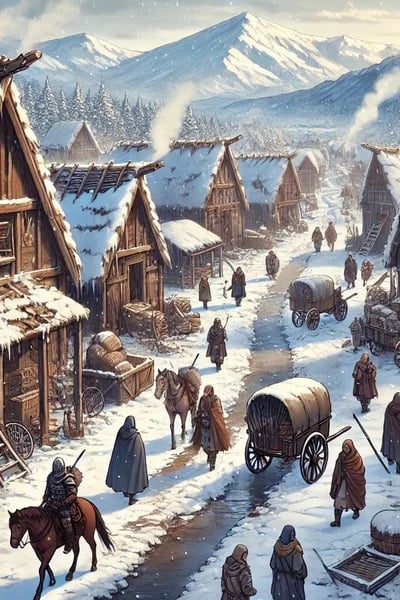
A week later, the grain caravan returned, its arrival a triumphant victory. The journey had been harrowing, including a nighttime attack by wild boars, but the guards had protected the precious cargo. The village itself had been transformed in their absence. A vast area of forest had been cleared to the north, making way for the planned longhouses. A new "log mover," a simple but effective machine, was in use, demonstrating Kivamus's innovative thinking. The foundation trenches for the first longhouse block were being dug, and the design for a square-shaped, defensible housing block with a central courtyard and communal kitchen was finalized. Kivamus also ordered the construction of a new palisade wall to surround the entire village, a massive undertaking that would provide security against future bandit raids. The work was divided into specialized teams, with foremen overseeing the logging, stump removal, and digging. Cedoron, the blacksmith, was producing a steady stream of axes, saws, and machetes, using a system of specialization to increase efficiency. The village was no longer a place of passive despair; it was a hive of purposeful activity, a community united in the struggle to survive and build a better future under the leadership of their unprecedented baron.
◆ Conclusion
The successful return of the grain caravan coincides with visible progress in construction, fortification, and innovation, solidifying Kivamus's leadership and the village's hope.
Character Lore Pantheon
Kivamus Ralokaar (formerly Steven)
analyticalcompassionateinnovative
A modern mechanical engineer from London who wakes up in the body of Kivamus, the exiled third son of the Duke of Ulriga. He is a man of logic and routine thrust into a brutal medieval world. His core stakes are survival and finding a way home, but he quickly becomes invested in the fate of his starving people. His trump card is his modern knowledge of engineering, medicine, and social systems, which he uses to solve problems in innovative ways, from designing a log mover to planning a seed drill. He navigates cutthroat politics with a blend of pragmatism and unprecedented compassion, abolishing slavery and choosing mercy over execution. His major plot turn is his decision to invest his personal fortune into the village's survival, cementing his role as a true leader.
Gorsazo
wisecautiousobservant
Kivamus's long-time mentor and advisor, who has served the Ralokaar family for generations. He is a scholar with a deep understanding of the kingdom's politics and the harsh realities of this world. His core stake is the survival and success of Kivamus, whom he has raised like a son. He is the first to notice the change in Kivamus's demeanor after the "revelation" of his new memories, though he does not press for the truth. His trump card is his network of knowledge and his ability to read people and situations. He provides the cautious, pragmatic counterbalance to Kivamus's more idealistic and innovative impulses, often warning of the political consequences of his actions.
Tesyb
determinedloyalprotective
A twenty-two-year-old former coal miner who has weathered a life of hardship. He lost his home in a bandit raid and is the sole provider for his aging parents. His core stake is the survival of his family, which drives him to volunteer as a manor guard despite having no combat training. His trump card is his raw physical strength, honed by years of labor, and a fierce, newfound loyalty to the baron who offers him and his family hope. His major plot turn is his selection as a guard and his participation in the dangerous grain caravan to Cinran, where he faces his first real combat against wild boars, marking his transition from a desperate miner to a budding protector of Tiranat.
Fair Use & IP Notice
MythFan is a community-driven, fan-contributed wiki & archive operating under Fair Use guidelines. MythFan does not host, store, or distribute any novel downloads or copyrighted media assets. All content is contributed and maintained by community members. If you believe any content infringes upon your intellectual property rights, please send a notice to [email protected] — we will review and remove infringing material within 3–7 business days upon verification.
💬
Sanctuary Discussion
From Londoner To Lord · Forum
🔑 Sign in to participate in discussions
Sign InProject Sanctuary · Native Discussion System