📊 Editorial Consensus89%
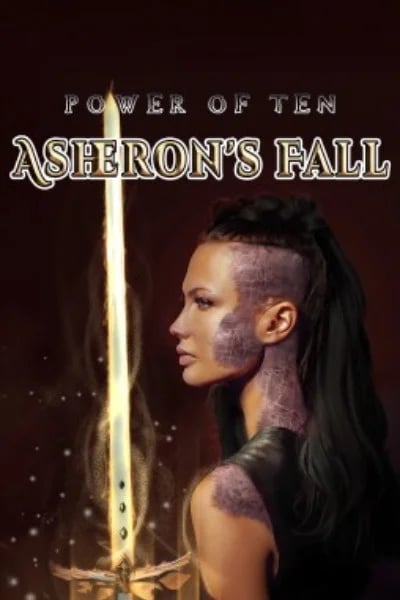
Asheron's Fall: The Power of Ten
by RE Druin
● CompletedRoyalroad
#LitRPG#Portal Fantasy / Isekai#Multiple Lead Characters#Strong Lead#Action#Adventure
Archivist Notes
Sand grits between teeth as consciousness snaps back into a bruised, unfamiliar spine. Aelryinth’s sixth soul shard, Zeks, does not wake gently. He wakes mid-collapse, having just hurled a Death Titan Necromancer Lich’s cursed backlash into the gullet of an eldritch tentacle-beast that was peeling the soul out of his new host, Devra al-Shamira. The explosion shatters the summoning circle, vaporizes the fungal mounds, and flings him through a ruptured dimensional veil into a world where magic runs on hexagonal metal scarabs, colored wax tapers, and a rigid tier system called Valences. Here, spells do not flow freely from a matrix. They require precise material combinations, ritual phrasing, and a mana pool that renews agonizingly slow compared to the akashic download system Zeks inherited. Worse, the land enforces a hard cap: one stat point, one feat, one mastery, and one level per natural day. Despite sitting on a billion karma points from eradicating an alien horror, Zeks is mechanically starved, forced to drip-feed growth like a leaking faucet. To survive the immediate threat of pursuing scholars and territorial bugs, Zeks abandons brute force for mathematical exploitation. He locates a menhir henge where raw ley-line mana pools in thick, unrefined currents, and begins stacking repetition counts against Cantrips and low-tier spells. Every twelve seconds yields a single mana cycle. By chaining Silver Mana Renewal with Aurora Stance, he pushes conversion past ten mana per minute, enough to refill spent valence slots without collapsing into exhaustion. This grind is not optional. It is the difference between casting a shielding ward and getting torn apart by acid-spitting beetle infantry. The henge becomes a temporary fortress, a place to test component substitution, map summon spawn points, and realize that local magic operates on chaotic variance while his matrix demands rigid control. He learns to strip material components using Sorcerer bloodline traits, turning complex taper rituals into mental constructs powered by crystal scarabs. But the henge only solves stamina. It does not solve scouting, or defense against intelligent predators. When shade entities descend to inspect the residual vivic fires, Zeks recognizes he lacks the mobility and raw durability to hold ground against multi-caster squads. He needs a partner who can walk through hostile wards, ignore magical drains, and close distance before evocative bolts lock on. The solution appears twenty-four hours later when a portal coughs out a null-bound princess armed with a living blade. Zeks trades tactical intel and sustained firepower for protection, but the alliance immediately fractures under logistical strain. Crystal scarabs run scarce. Air gold coins pile up but lack magical resonance. Without proper forging tools, enchanting gear stalls. The rep counts must continue, but the road ahead is littered with territorial drudges, necrotic patrols, and ancient death-crystal pits that hint at a society murdered mid-resurrection. Survival requires moving south, tracking rivers, and accepting that the next town will demand more than just spell slots.
I was the sixth cut-off portion of Aelryinth’s soul, and I was still rather surprised when the voice broke over me, and I understood the magic of it.
Asheron's Fall: The Power of Ten
Story Chronicles
NODE 01The Karmic Bottleneck and the Henge Grind
karmic bottleneckhenge grindingsystem collisionnull alliance
Archivist Insights
The moment Zeks stabilizes inside Devra’s ruined body, the true crisis reveals itself. His internal diagnostics flash a staggering one hundred and four in Isparian terms, backed by a billion karma points. Yet the system slams a mechanical brake on every single advancement. One stat point per day. One feat. One mastery. One level. The universe does not care that he just purged an eldritch abomination. It forces him to drip-feed growth like a leaking faucet. To survive the immediate threat of pursuing scholars and territorial bugs, Zeks abandons brute force for mathematical exploitation. He locates a menhir henge where raw ley-line mana pools in thick, unrefined currents, and begins stacking repetition counts against Cantrips and low-tier spells. Every twelve seconds yields a single mana cycle. By chaining Silver Mana Renewal with Aurora Stance, he pushes conversion past ten mana per minute, enough to refill spent valence slots without collapsing into exhaustion. This grind is not optional. It is the difference between casting a shielding ward and getting torn apart by acid-spitting beetle infantry. The henge becomes a temporary fortress, a place to test component substitution, map summon spawn points, and realize that local magic operates on chaotic variance while his matrix demands rigid control. He learns to strip material components using Sorcerer bloodline traits, turning complex taper rituals into mental constructs powered by crystal scarabs. But the henge only solves stamina. It does not solve scouting, or defense against intelligent predators. When shade entities descend to inspect the residual vivic fires, Zeks recognizes he lacks the mobility and raw durability to hold ground against multi-caster squads. He needs a partner who can walk through hostile wards, ignore magical drains, and close distance before evocative bolts lock on. The solution appears twenty-four hours later when a portal coughs out a null-bound princess armed with a living blade. Zeks trades tactical intel and sustained firepower for protection, but the alliance immediately fractures under logistical strain. Crystal scarabs run scarce. Air gold coins pile up but lack magical resonance. Without proper forging tools, enchanting gear stalls. The rep counts must continue, but the road ahead is littered with territorial drudges, necrotic patrols, and ancient death-crystal pits that hint at a society murdered mid-resurrection. Survival requires moving south, tracking rivers, and accepting that the next town will demand more than just spell slots.
◆ Conclusion
Daily caps force arithmetic survival, birthing a matrix-isparian hybrid that demands constant rep counts and tactical partnerships.
NODE 02The Drudge Purge and the Death-Crystal Revelation
urban purgedeath crystalselite massacresummon warfare
Archivist Insights
Crossing into the former Aluvian capital transforms a skirmish into a coordinated slaughter. Zeks maps the urban grid from cover while Kristie, shielded by her null interdiction, ghosts through buildings, silencing sentries and harvesting naming karma. The drudges operate on instinctual warbands, their color-coded warriors routing toward hunting grounds while lesser drones guard static summon circles. Zeks identifies the pattern. These creatures farm ectoplasmic respawns to maintain territorial dominance, turning the city into a passive kill-zone. Rather than trigger alarms, he targets the ecosystem’s foundation. Vivic darts ignite unwhite bonfires across corpse mounds, consuming bone dust and fungal spores alike. Summon points seal shut when fed to the land, starving the drudges of reinforcements. The strategy works until shade entities arrive, floating assassins wreathed in negative energy and copper-tier war magic. Kristie’s null swallows their draining rays, but the shadows coordinate with precision, buffing force armor and piercing resistance before striking. Zeks counters by pre-loading vulnerability spells, painting the lead shade with fire susceptibility before unleashing rainbow shard volleys. The fight exposes a critical weakness. Isparian combat favors telegraphed casts and rigid spell structures, while his matrix demands instant adaptation and descriptor stacking. After burning through three hundred mana to secure the perimeter, they turn inward to investigate the ruin’s deeper secrets. Beneath collapsed basements and flooded cellars lie blue crystalline death sites. Hundreds of fused skeletons, impaled by shattered geodes, reveal a catastrophic teleportation failure. The bones did not burn. They merged. Bodies disassembled, stored as data, and rematerialized simultaneously before the central crystal overloaded, fusing flesh and stone in a single millisecond. The implication lands like a hammer blow. The island’s ruling class, wielding charged artifacts and ley-tapped devices, died instantly when the veil hardened and mana surged backward through their gear. The survivors were stripped of infrastructure, left to fend off native tribes and undead legions. This is not a natural apocalypse. It is an engineered collapse, a mass culling disguised as disaster. With the drudges isolated and the shades driven back, Zeks realizes the summon grid was never meant for entertainment. It was a military training loop, feeding endless troops to test recruits and harvest karma. The resurrection protocol still hums beneath the surface, waiting to pull dead souls back into fresh bodies. If the crystals can resurrect the living, they can resurrect the dead. The moral calculus shifts violently. Killing becomes sustainable farming. But sustainability breeds arrogance, and arrogance draws bigger threats. Beyond the lake, something the size of a house paces the shallows, its health qi regenerating faster than silver bolts can pierce it. The drudge purge bought time, but the real war is underwater.
◆ Conclusion
Coordinated tactics clear the capital, exposing a engineered societal collapse and a resurrection protocol that turns combat into sustainable farming.
NODE 03The Tribal Fracture and the Pirate Encounter
tribal warfareundead loyaltybriggs legacynaval mobilization
Archivist Insights
Leaving the ruined capital forces movement along the river, where ecology and politics fracture into overlapping tribal zones. The swamp gives way to muddy floodplains patrolled by burun frog-men, green-scaled mosswarts, armored lugian brutes, and militaristic hea tumerok hunters. Each faction controls distinct terrain, trading null-aluminum scrap and anti-magical weapons to counter spellcasters. Zeks watches from invisible vantage points as burun shamans direct cold-blasted war councils, tumerok elders fortify wooden palisades with living root-walls, and lugian scouts hurl gravity-enhanced boulders at aerial threats. The landscape is a pressure cooker, simmering with territorial disputes and ancient grudges. Summon points act as both barricades and bait, cycling through reedsharks, banderlings, and mutated gromnies to test invaders. Zeks realizes the natives are adapting to a broken world by hoarding resources, banning magical dependency, and treating combat as a zero-sum exchange. None of them know about the islands to the east, where surviving humans likely fled behind sealed wards. That ignorance becomes a liability when undead pirates emerge from the treeline, rust-cutlasses drawn and Aluvian accents roughened by decades of decay. These are not mindless zombies. They are second mates and captains who died defending refugee caravans, bound to the land by oath and necrotic residue. Kristie steps forward without hesitation, dropping the invisibility cloak to let them see her fully. She does not draw steel to threaten. She draws it to intimidate, invoking the name of Emperor Briggs and the MacRugal blacknames with surgical precision. The undead captain hesitates, then drops to one knee, his crew following in rattling unison. The revelation reframes everything. The pirates did not fall to enemy blades. They fell protecting civilians, only to rise as undead anchors holding the peninsula. Their commander waits in the dead city of Hebian-to, a relic of the old empire now occupied by desperate survivors. Zeks processes the implications rapidly. If the MacGuires survived the initial collapse, other loyalist fleets might exist. Naval evacuation routes could be reopened. The eastern islands are not a graveyard. They are a staging ground. But reaching them requires securing supply lines, neutralizing the monuga apex predators, and convincing tribal leaders to abandon centuries of isolation. The rep counts will have to double. The artifact crafting will have to accelerate. And the matrix will have to evolve past valence limitations into higher tiers of spell synthesis. The road south is no longer a trek. It is a mobilization order.
◆ Conclusion
Tribal friction and pirate loyalty expose a hidden survivor fleet, transforming exploration into a logistical campaign for eastern evacuation.
NODE 04The Sublime Chord and the Arcane Horizon
bardic synergyheartsong matrixcontinental wardseternal climb
Archivist Insights
Progress demands more than raw damage. It demands control, amplification, and the ability to bend the battlefield without burning through valence slots. Zeks pivots his build toward Heartsinger progression, stacking Minstrel ranks, Chorister feats, and Battledancer abilities to transform performance into tactical leverage. Metamagic Song converts minstrel channeling into arcane pool fuel, while Lyric Spell bridges vocal projection directly into spellcasting matrices. The result is a feedback loop. Song boosts morale, morale sustains focus, focus accelerates mana conversion, and converted mana refills spell slots without meditation. Every rep count against a frozen tree or mist-shrouded hill tightens the link between vocal range and arcane yield. At forty-plus perform checks, his Salute to Aru carries across miles, syncing dawn renewal with personal mana resets. This is not mere utility. It is structural evolution. The Power of Ten system rewards specialization, but the Isparian world punishes rigidity. By weaving Bardic progression into his primary matrix, Zeks bypasses the traditional druidic barrier, accessing primal harmonies through heartsong instead of land communion. He learns to cast full spells from minstrel uses, effectively doubling his daily action economy. Yet the horizon remains vast. The obelisk wards stretching along the river prove someone once engineered continental-scale barriers, only to watch them fry during the mana surge. The death-crystal pits suggest resurrection technology far beyond mortal comprehension. The virindi hiveminds operating through porcelain masks hint at extraplanar architects who built this summon grid from scratch. None of it aligns with natural magic. Every ley line feels routed, filtered, and artificially concentrated. Someone is playing god with mana fields, and someone else is cleaning up the fallout. Zeks knows he cannot outrun the truth. He must climb the ladder, push past six, break ten, and finally access the eternal ceiling. Until then, he grinds. He sculpts stone wagons, invests air gold into null-proof necklaces, and practices lightning reserves until thunder descriptors bleed into every firebolt. The next town holds tumerok fish-runs, buried artifice pits, and possibly a functioning shipyard. The monuga lurks in the deep water, waiting for a mistake. The shades circle the edges, patient and hungry. But for the first time since the curse severed him from his original soul, Zeks has a rhythm. Rep counts sync with tidal flows. Shard volleys match drumbeats from distant war camps. Heartsong echoes across flooded valleys. The grind is no longer a prison. It is a cadence. And cadences build armies.
◆ Conclusion
Vocal-matrix fusion breaks action limits, turning daily grind into tactical rhythm while revealing engineered world-systems demanding higher ascension.
Character Lore Pantheon
Zeks / Devra al-Ryinth
analyticalruthlessadaptable
Carrying the fractured memories of Aelryinth, Zeks pilots Devra’s body while bridging two incompatible magical architectures. He treats mana as a budget, stacking descriptors and meta-feats to bypass Isparian limitations, but remains constrained by daily karma caps. His survival depends on relentless rep counts, component scavenging, and precise targeting. He avoids direct melee, favoring ranged volleys, environmental manipulation, and psychological warfare. His greatest strength is systemic thinking. His greatest weakness is underestimating physical threats until they breach his wards.
Princess Kristie Rantha
pragmaticfearlesshonor-driven
Born with a curse that grants immortal martial prowess but strips magical affinity, Kristie walks through hostile wards unscathed and swallows evocative bolts whole. She wields Quaver, a living blade that consumes enchanted weapons to grow stronger, and moves with Jotun-level velocity. Her null interdiction disrupts spellcasting, making her the perfect counter to Isparian casters. She balances royal duty with savage pragmatism, viewing combat as a craft to be mastered and alliances as tactical necessities. Her loyalty is earned through competence, not title.
Mira / Shamira
curiouscautiousintellectually rigorous
A leftover echo of Devra’s original consciousness, Mira exists as a secondary thoughtstream within Zeks’ mind. She provides encyclopedic knowledge of Isparian spellcraft, taper combinations, and cultural history, but struggles to reconcile rigid local traditions with Zeks’ fluid matrix approach. She acts as a reality check, warning against reckless mana expenditure and component waste. Though she lacks physical agency, her analytical contributions prevent catastrophic missteps, and her gradual acceptance of hybrid magic mirrors the world’s own reluctant evolution.
Fair Use & IP Notice
MythFan is a community-driven, fan-contributed wiki & archive operating under Fair Use guidelines. MythFan does not host, store, or distribute any novel downloads or copyrighted media assets. All content is contributed and maintained by community members. If you believe any content infringes upon your intellectual property rights, please send a notice to [email protected] — we will review and remove infringing material within 3–7 business days upon verification.
💬
Sanctuary Discussion
Asheron's Fall: The Power of Ten · Forum
🔑 Sign in to participate in discussions
Sign InProject Sanctuary · Native Discussion System