📊 Editorial Consensus89%
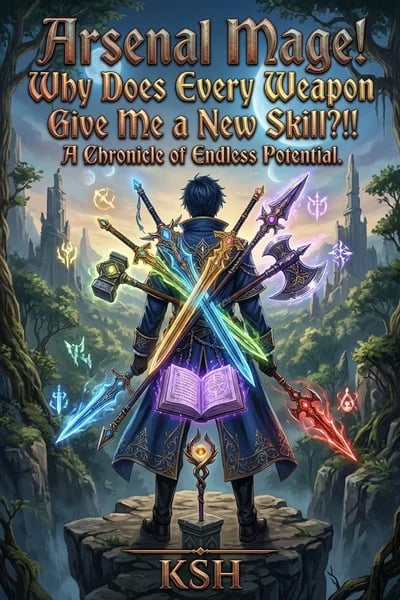
Arsenal Mage! Why Does Every Weapon Give Me A New Skill?
by KSH
● OngoingRoyalroad
#Comedy#Action#Adventure#Fantasy
Archivist Notes
Aiden Winters steps off the last train of his old life with the dull certainty of a man who has already lost to rent, friendship, and middle management. The city has squeezed him into a small apartment, a transfer order, and a subway platform so empty that his own sarcasm sounds like a warning. He is not a hero, not a chosen warrior, and not a man built for destiny. He is a tired office worker with bad shoes, a social life that is slowly becoming a graveyard of group chats, and a soul tired enough to let the world keep its secrets.
Then the platform pushes him toward the rails, and the light of the last train becomes a doorway instead of a death sentence. He wakes in a cave carved from ancient stone, his body cleaned of pain, his clothes unchanged, and his modern world erased without a single explanation. The mountain above him is too large, the sky too blue, the birds too terrible, and the forest beyond the trail smells of rot, blood, and things that have never heard the word please.
The story fuses modern emotional realism with system fantasy, and the fusion is the real cheat. Aiden does not gain a noble blade, a princess, or a goddess. He gains a blue screen that recognizes a tree branch, a floating inventory called the Arsenal, and a rule that every weapon he touches can become a teacher, a stat source, and a new survival option. His humor becomes armor, his greed becomes strategy, and his refusal to die becomes the engine of a world where a stick, a rusty knife, a shield, a book, and a pair of boots can all be weapons if he is desperate enough. The comedy keeps the violence from becoming pure spectacle, because Aiden treats every apocalypse like a bad performance review with no map, no phone, and no one to call. His origin is not a blessing. It is a promotion with no benefits and no exit strategy. The world is hostile, but the rules are learnable soon for him.
Every weapon could change him.
Arsenal Mage! Why Does Every Weapon Give Me A New Skill?
Story Chronicles
NODE 01Subway Push and Weapon System
isekaisystemfirst kill
Archivist Insights
Aiden's miserable commute becomes the first kill of the story when the empty subway platform pushes him toward the rails with no witness and no warning. The train light swallows him, but instead of death he wakes in a cave of ancient stone, his body restored, his phone gone, and his old life reduced to a jacket, jeans, and a sneaker that is already failing. He is not dropped into a hero tutorial. He is dropped into a mountain that has truck sized birds, a forest that smells of rot, and a body count that has not been explained to him. His sarcasm survives because it is the only tool he brought with him. He tests the cave, breaks ancient furniture by touching it, and learns that this place has been abandoned so long that even dust has a deadline. The moment becomes cinematic because the audience understands the emotional bruise before the fantasy rule arrives. Aiden is not excited. He is angry, hungry, and trying to avoid becoming a cautionary tale. Then the goblins find him, and the story shifts from survival panic to weaponized comedy. Aiden grabs a fallen branch, not because he believes in destiny, but because it is the only object nearby that can make a loud noise. The System appears in blue light, recognizes the branch, and gives it a level, damage, durability, growth, and a skill called Bash. The reversal is immediate. A man with no training, no armor, no money, and no friends suddenly has a weapon that can make his panic useful. The first fight is ugly, messy, and full of headbutts, but the branch turns his fear into a double damage swing. He kills the goblins, levels the branch, and discovers that the weapon is not becoming stronger while he is. The weapon gives him the stat. The hook lands hard. He is bleeding, the forest is still hunting, and the blue screen has just told him that his stick has a career path. He has no map, no allies, and no chance to ask for a refund. The forest keeps moving, and the goblins behind him are already becoming a rumor that wants a body.
◆ Conclusion
Aiden's ordinary despair becomes a weaponized survival cheat, turning a stick into his first power and the story's engine.
NODE 02Goblin Forest Arsenal Awakening
arsenalskill theftgoblin hunt
Archivist Insights
The goblin fight becomes a lesson in how the System turns violence into curriculum. Aiden loots the corpses and discovers that the Arsenal is not just storage. It is a growing collection of ugly weapons, each one with its own skill, growth line, and stat promise. The rusty knife gives Dexterity, the hatchet gives Throw, the cleaver gives Chop, the club gives Smash, and the broken spear is rejected by the System but still useful because Aiden can borrow the skill shape from another weapon. This is the core face slapping moment. A normal person would be helpless in a monster forest, but Aiden becomes a walking tutorial. He tests the rejected spear, throws it with a borrowed skill, stabs with a borrowed motion, and bashes with anything heavy enough to swing. The forest stops being only a place where he might die and becomes a place where he can learn. The escalation is practical and terrifying. He is not just surviving. He is building a build. His stamina becomes a budget, his health becomes a warning, and his Arsenal becomes a library of stolen technique. The goblins are no longer only enemies. They are walking weapon racks. The hook arrives when Aiden finds goblin territory, sees multiple patrols, a camp, smoke, and a possible boss, and realizes that his first real problem is not one goblin but a whole hostile society. He is alone, injured, and armed with a collection of trash that is slowly becoming a military doctrine. The horns begin to sound, and the forest turns into a hunting ground with Aiden as the prey. He has learned the most dangerous thing in a survival story. He can improve while the enemy is still deciding whether he is worth the calories. The goblins have numbers, terrain, and hatred. Aiden has pacing, ambush, and a growing list of skills that make every next fight less impossible. The humor is not a break from the danger. It is the danger wearing a sarcastic jacket. He knows he is not ready for a camp, but the camp is full of knives, bows, shields, and future stat points. The real cliffhanger is not whether he can kill one more goblin. It is whether he can turn his cowardice into a strategy before the whole territory learns his name.
◆ Conclusion
The Arsenal turns enemies into lessons, making every stolen weapon a stat source and a route to impossible competence.
NODE 03Goblin Camp and Hex Staff
camp raidmagic staffdual shields
Archivist Insights
Aiden turns the goblin camp into his first conquest because survival has become a business model. He raids the camp at dawn, steals food and water, kills guards, and escapes while the whole camp wakes up behind him. The reversal is that the camp, which should be a source of safety, is the worst place to go, but it is also the only place with supplies. His desperation becomes precision. He uses the smell of meat, the sound of a pot, and the goblin routine to find his way to the jars and the waterskins. The face slapping moment arrives when he is not just taking food. He is taking their entire cultural identity. Weapons, shields, bows, a machete, and eventually the shaman staff all enter the Arsenal. The camp fight escalates from a supply theft into a population management operation. Aiden unlocks dual shields, becomes a very angry door, and uses the chief and the shaman against each other by turning a fireball into friendly fire. The shaman staff gives him magic, finally opening his mana pool and making him a threat beyond raw violence. The climax is ugly and cinematic. He burns the shaman, cuts the chief, and stands in the center of the camp with a skull staff glowing in his hand. The hook is not victory. The hook is consequence. He has won the camp, but he has also made himself a target for every goblin that can tell a story. The survivors will return with anger, numbers, and a name for the stranger who burned their magic. He leaves the camp with food, water, boots, coins, and proof that humans or human sized beings exist, but the forest ahead is no longer a simple survival problem. It is a political problem with teeth. He also discovers the next layer of the world. There is a goblin town beyond the camp, with walls, patrols, cages, and prisoners. The camp was not the whole enemy. It was the front porch. The town is the house, and the house has people inside it who may be human. That detail changes Aiden's goal from escape to rescue, even though rescue is the most dangerous kind of greed.
◆ Conclusion
His violent resourcefulness escalates from camp raid to magic theft, proving that survival can become conquest and escalation.
NODE 04Human Town and Spider Mine
guildlanguage grindspider boss
Archivist Insights
The human town turns Aiden's story from monster survival into social survival. He is captured by the rescue party, chained in a cage, and brought into a town that has walls, mages, soldiers, and a language he cannot speak. The reversal is bitter. The people he saved do not thank him. They lock him up. Marrec, the scarred old soldier, becomes his interrogator, his teacher, and the first person who treats him less like a monster and more like a problem that might be solved. Aiden's greatest weapon in the stone room is not the Arsenal. It is books. The System accepts reinforced books as weapons, and his week of forced literacy becomes a grind that gives him Intelligence, Wisdom, and passive skills. The face slapping moment is educational. He is not defeated by magic. He is defeated by alphabet books, picture readers, and grammar, but the punishment becomes power. The town is invaded by armored lizard soldiers, and Aiden escapes his cell by burning his chains with Hex Flame. He fights enough to pay for his food, his room, and his humiliation, then leaves before he becomes a hero. The hook is not the invasion. It is the next door. He joins a young adventurer party, hides his Arsenal behind an archer disguise, and goes into a mine where a spider colony has trapped survey workers. The final boss is a giant spider with poison, web walls, and a second phase that tests the whole group. Aiden wins by planning, by smoke, by archery, and by almost revealing his true power. The cliffhanger is economic and strategic. He has money, a guild badge, a party that is suspicious, and a mine full of loot. He also needs a rare weapon, real money, and a way to keep his secrets alive while the world keeps opening new rooms full of monsters. The guild gives him legitimacy, but legitimacy is a leash. The party gives him a reason to fight, but their trust is a thin layer of paint over suspicion. The mine gives him tools, gloves, boots, and a pickaxe, which tells him that his Arsenal can become an entire profession. The next problem is not just a monster. It is the price of becoming a person in a world that charges for beds, baths, and the right to be believed.
◆ Conclusion
Civilization offers both shelter and suspicion, forcing Aiden to trade secrecy for legitimacy while his power outgrows his cover.
Character Lore Pantheon
Aiden Winters
sarcasticresourcefuldesperate
Aiden's core stake is staying alive without becoming a monster or a prisoner. His trump card is the Arsenal, which turns any useful object into a leveling weapon, stat source, skill teacher, and storage item. His major plot moves include surviving the subway push, killing goblins, conquering a camp, escaping human custody, and proving himself in the spider mine while hiding the full depth of his power.
Marrec
suspiciousdisciplinedpatient
Marrec's stake is keeping the town safe from a stranger who may be a spy, a monster, or a liability. His trump card is decades of combat experience, a silver sword, and an ability to read people through silence. He tests Aiden in the stone room, teaches him language by force, fights a lizard commander during the invasion, and becomes the moral benchmark that shows Aiden the difference between system power and earned skill.
Garran Holt
responsiblecautiousambitious
Garran's stake is completing a mission that is larger than his Copper ranked party can safely handle. His trump card is leadership, shield work, and a willingness to recruit Aiden despite suspicion. He leads the mine rescue, coordinates the smoke and archery plan, survives the giant spider boss, and represents the social world Aiden must enter if he wants legitimacy, money, and a future beyond hiding.
Fair Use & IP Notice
MythFan is a community-driven, fan-contributed wiki & archive operating under Fair Use guidelines. MythFan does not host, store, or distribute any novel downloads or copyrighted media assets. All content is contributed and maintained by community members. If you believe any content infringes upon your intellectual property rights, please send a notice to [email protected] — we will review and remove infringing material within 3–7 business days upon verification.
💬
Sanctuary Discussion
Arsenal Mage! Why Does Every Weapon Give Me A New Skill? · Forum
🔑 Sign in to participate in discussions
Sign InProject Sanctuary · Native Discussion System